
Capsule and Granulation Sourcing: 7 Smart Checks Before Scale-Up
Capsule and granulation sourcing is often treated as a final procurement step after the formulation has already been approved.
That can create problems.
A formulation may look complete on paper, with the active ingredients, excipients and target dosage already defined. But when the project moves toward pilot production or scale-up, the team may discover that the powder does not flow consistently, the target fill weight is difficult to achieve, the selected capsule shell does not fit the intended market, or the formulation needs granulation before it can run reliably on the production line.
At that point, the problem is no longer simply formulation development. It becomes a dosage-form and sourcing problem.
Capsule filling performance is strongly influenced by powder properties. Research has shown that powder flow characteristics can significantly affect capsule fill weight and weight variability, while particle size, density, cohesion and compressibility can all influence filling behavior.
This is why capsule shells and granulation should be considered earlier in the development process rather than left until the final purchasing stage.
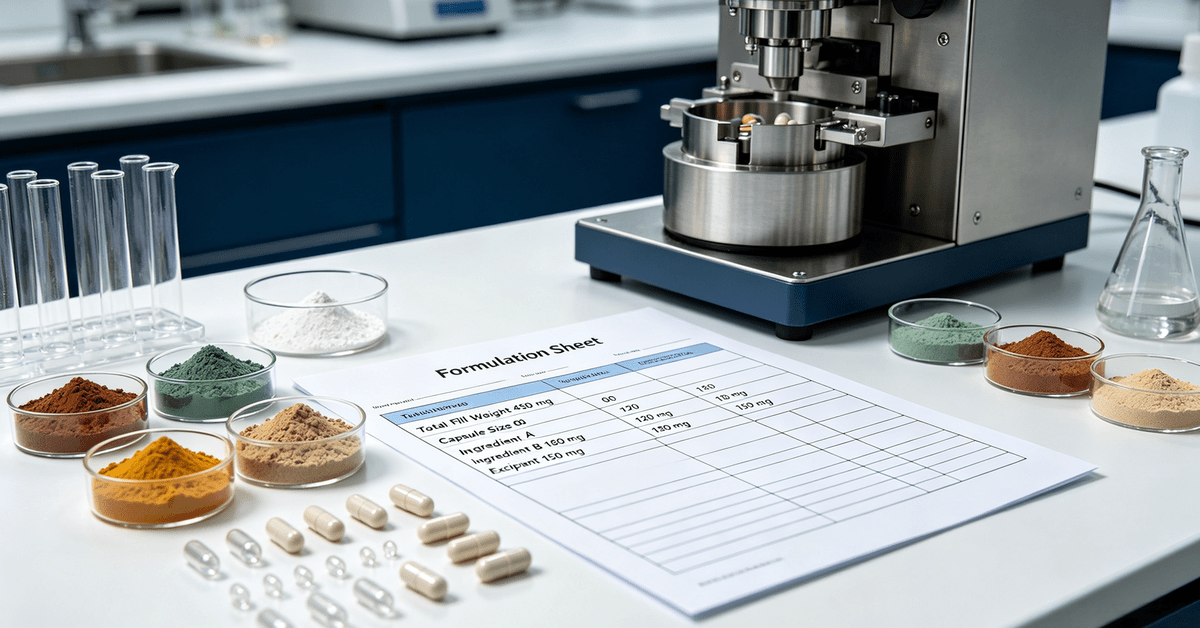
Capsule and Granulation Sourcing Starts with the Dosage Form
Before selecting a capsule supplier or granulation process, the intended dosage form should be clearly defined.
For a capsule project, this may include:
- Hard capsule or another capsule format
- Gelatin or vegetarian capsule shell
- Target capsule size
- Target fill weight
- Powder or granulated fill
- Color and appearance requirements
- Printing or branding requirements
- Market-specific requirements
Hard gelatin capsule shells, for example, consist primarily of gelatin and water and may contain additional components such as colorants, opacifiers and other processing aids.
For nutraceutical and functional-ingredient products, vegetarian or plant-based capsule options may also be considered depending on the product positioning and target market.
The important point is that capsule selection should not happen independently from the formulation.
A capsule has a defined physical volume, while the formulation has a defined mass, bulk density and flow behavior. These variables have to work together.
1. Match Capsule Size with the Actual Fill Requirement
One of the most common procurement mistakes is choosing a capsule size based only on the amount of active ingredient.
The actual filling requirement depends on the total formulation weight and the physical characteristics of the blend.
Two formulations containing the same amount of active ingredient can require different capsule sizes because their excipient composition, bulk density, particle size and packing behavior are different.
For this reason, the development team should establish at least:
- Total fill weight per capsule
- Approximate bulk density
- Target capsule size
- Expected fill-weight variation
- Powder or granule characteristics
- Filling equipment or filling method
A theoretical calculation may help with initial screening, but actual filling trials are much more informative.
A formulation that fits within a particular capsule volume on paper may behave differently when it reaches the filling machine.
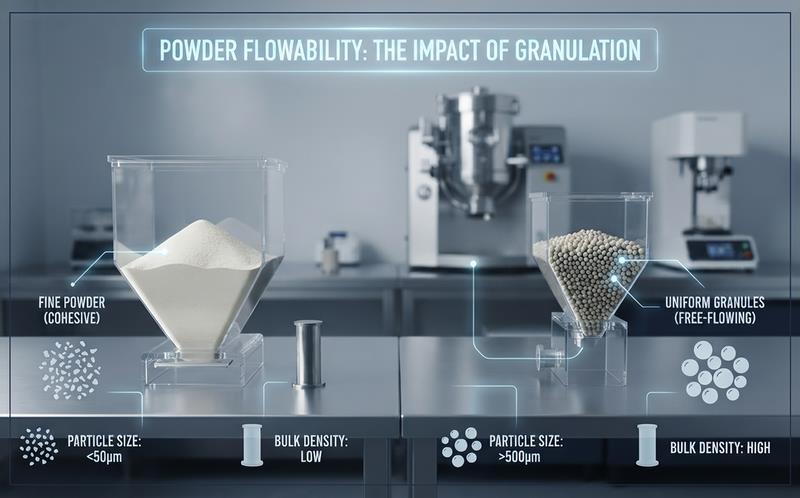
2. Evaluate Powder Flow Before Blaming the Capsule
When capsule filling becomes inconsistent, the capsule shell is not necessarily the problem.
Powder behavior can be the limiting factor.
Poor flowability may contribute to inconsistent feeding, bridging, segregation, variable fill weights and difficulties during automated filling. Published research has found a significant relationship between powder flow properties and capsule fill weight and weight variability.
Relevant powder characteristics may include:
- Particle size distribution
- Bulk density
- Tapped density
- Compressibility
- Cohesion
- Particle morphology
- Moisture content
- Electrostatic behavior
- Flowability
This is particularly important when a formulation contains several low-dose active ingredients or fine powders.
A formulation can meet its chemical specifications and still perform poorly during manufacturing because its physical properties are unsuitable for the selected process.
That is why a COA alone may not tell the whole manufacturing story.
3. Decide Whether Granulation Is Actually Necessary
Granulation should not automatically be viewed as an additional processing step.
It should be considered when the powder properties create a practical manufacturing problem that cannot be adequately addressed through formulation adjustment or process optimization.
Granulation can modify particle size, density and flow characteristics. Pharmaceutical literature describes granulation as a process used to improve properties such as flowability, compressibility and the handling of powder blends.
Depending on the formulation, options may include wet granulation, dry granulation or other particle-engineering approaches.
The choice should depend on the material and the intended process.
For example, a moisture-sensitive formulation may require a different approach from a formulation that can tolerate an aqueous granulation step. Similarly, a formulation containing heat-sensitive components may require careful consideration of processing conditions.
The procurement question therefore should not simply be:
“Can this supplier provide granulation?”
A better question is:
“Which granulation process is suitable for this formulation, and what specifications can the supplier consistently achieve?”
4. Define Granule Specifications Before Ordering
Once granulation becomes part of the project, the granulated material should be treated as a defined intermediate rather than simply “processed powder.”
The specification may need to address:
- Particle size distribution
- Moisture content
- Bulk density
- Flowability
- Granule strength
- Fines content
- Appearance
- Active content
- Content uniformity, where applicable
- Storage conditions
- Packaging
Particle size is particularly relevant because excessive fines may negatively affect flow, while excessively large or dense granules may behave differently during filling or downstream processing.
Granulation research also shows that changes in excipient composition and processing conditions can affect granule size, density, compressibility and flow behavior.
This means that a granulation supplier should not be evaluated only by whether it can produce granules. The more important question is whether it can repeatedly produce granules within the required physical and chemical specification.
5. Check Compatibility with the Target Market
Capsule selection can also be influenced by the target market.
For some products, gelatin may be acceptable. For others, the formulation may require a vegetarian or plant-based capsule.
The same applies to certification and market-specific requirements.
Depending on the target market and product positioning, procurement teams may need to confirm requirements related to:
- Vegetarian or plant-based status
- Halal
- Kosher
- BSE/TSE documentation, where relevant
- Allergen considerations
- Colorants
- Packaging
- Regulatory documentation
- Manufacturing-site qualifications
These requirements should be identified before the capsule shell is selected.
Otherwise, the team may complete formulation development with a capsule that later needs to be replaced because it does not satisfy the commercial or market requirements.
That replacement can affect sampling, artwork, packaging specifications and production scheduling.
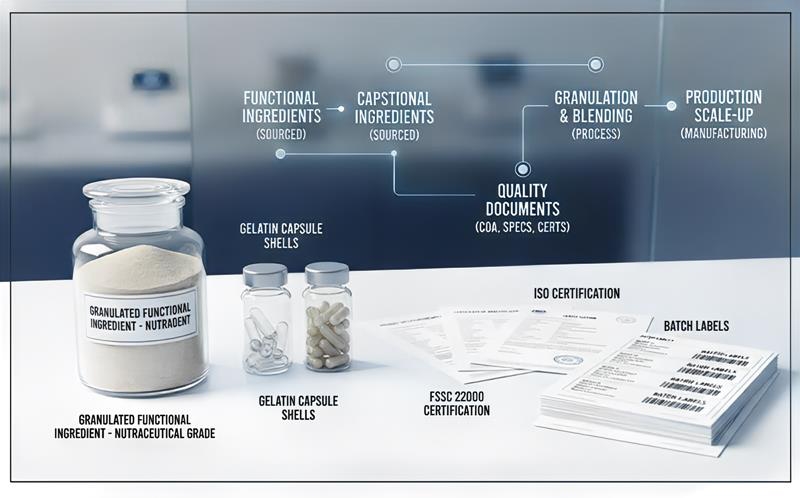
6. Request Documents for the Capsule Shell and Granulated Material
Capsule shells and granulated intermediates should have their own documentation.
For capsule shells, procurement may need to request:
- Product specification
- Material composition
- Certificate of Analysis
- Microbiological specifications
- Color specifications
- Dimensions and physical specifications
- Storage conditions
- Relevant certifications
- Manufacturing information
For granulated material, the documentation may additionally include:
- Granulation process description
- Particle size specification
- Moisture specification
- Bulk density
- Active-content testing
- Relevant process controls
- Batch-specific COA
- Shelf-life or storage information
The exact document package will depend on the product, market and manufacturing model.
The objective is to make sure the physical component being purchased can be qualified just as carefully as the active ingredient.
7. Test the Complete System Before Scale-Up
The final and most important check is to evaluate the formulation, capsule shell and filling process as a system.
A good powder may perform differently after blending with other ingredients.
A suitable capsule shell may still be difficult to use if the formulation has poor flow.
A successful laboratory blend may also behave differently during larger-scale filling.
This is why pilot-scale or representative filling trials can be valuable before committing to full production quantities.
The evaluation should consider:
- Actual fill weight
- Fill-weight variation
- Machine performance
- Powder feeding
- Segregation
- Capsule closing
- Appearance
- Defect rate
- Granule behavior
- Stability and storage considerations
FDA manufacturing guidance for dosage-form manufacturers also recognizes the need for controls and in-process testing around capsule filling operations.
The goal is not simply to prove that the capsule can be filled once.
The goal is to establish that the selected formulation and capsule system can be manufactured consistently.
What Should Procurement Ask Before Approving a Capsule or Granulation Supplier?
A practical first-round supplier checklist can include:
- What capsule materials and types are available?
- Which capsule sizes are suitable for the target fill weight?
- Can vegetarian and gelatin options be supplied?
- What certifications and quality documents are available?
- What are the capsule dimensions and specifications?
- Does the formulation require granulation?
- If granulation is required, which process is proposed?
- What particle size, moisture and bulk-density specifications can be controlled?
- Can a representative sample be provided for filling trials?
- Can the same specification be maintained during commercial production?
These questions help separate a simple component supplier from a supplier that can support the actual manufacturing requirements of the project.
The Formulation Is Not Finished Until the Dosage Form Works
A formulation is not truly production-ready simply because the ingredient list has been finalized.
The physical behavior of the blend, the capsule specification, the filling process and, where necessary, the granulation process all have to work together.
That is why capsule and granulation sourcing should be considered during formulation development rather than treated as a final purchasing task.
At Esubio, our Capsule Shells & Granulation Solutions are designed to complement functional ingredient sourcing, allowing buyers to evaluate raw materials and dosage-form requirements within the same sourcing process. Depending on the project, this can include capsule shell options, granulation support and relevant product documentation.
For projects that are already technically defined but not yet production-ready, the most useful question may not be:
“Where can we buy the capsule?”
It may be:
“Does the capsule, formulation and powder-processing approach actually work together?”
Answering that question earlier can help reduce last-minute sourcing, formulation changes and avoidable delays during scale-up.
References
Effects of powder flow properties on capsule filling weight uniformity — PubMed
https://pubmed.ncbi.nlm.nih.gov/23902366/Comparative evaluation of powder flow parameters with reference to particle size and shape — PubMed
https://pubmed.ncbi.nlm.nih.gov/29803793/USP-NF — Hard Gelatin Capsule Shells
https://doi.org/10.31003/USPNF_M9475_02_01Granulation techniques and technologies: recent progresses — PMC
https://pmc.ncbi.nlm.nih.gov/articles/PMC4401168/Advances in Twin-Screw Granulation Processing — PMC
https://pmc.ncbi.nlm.nih.gov/articles/PMC8146340/FDA — Dosage Form Drug Manufacturers cGMPs
https://www.fda.gov/inspections-compliance-enforcement-and-criminal-investigations/inspection-guides/dosage-form-drug-manufacturers-cgmps-1093