
What Is SEV? A Practical Guide to Comparing Stevia Sweetness Potency
Two stevia spec sheets can both say “300 times sweeter than sugar” and still not be directly comparable — because stevia sweetness potency isn’t a fixed number. It changes depending on the concentration being measured, the reference sucrose solution used, and the specific glycoside profile of the extract. SEV — sucrose equivalent value — is the concept the industry actually uses to standardize that comparison.
Why a single potency number is misleading
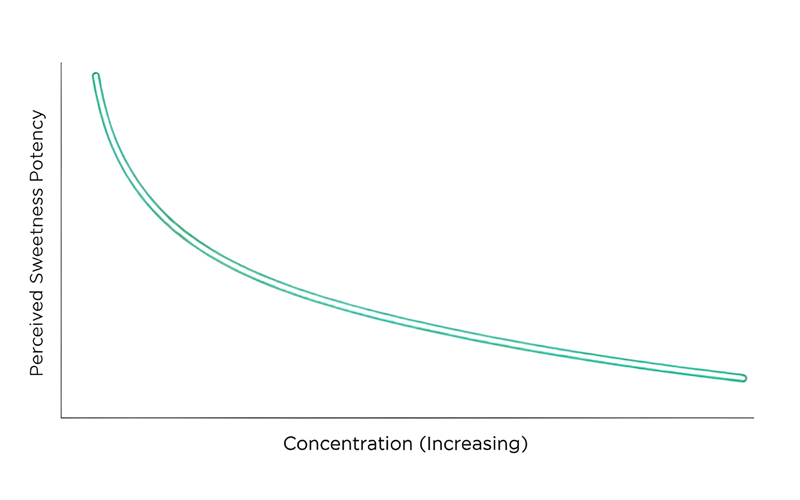
Sweetness intensity for high-intensity sweeteners generally isn’t linear relative to concentration — most non-nutritive sweeteners, stevia included, show diminishing relative potency as concentration increases. A stevia extract quoted as “300x sweeter” at a low-concentration reference point (say, 2.5% sucrose-equivalent sweetness) will typically show a meaningfully lower relative potency at a higher reference point (say, 7.5%). Without knowing which %SE the quoted number is based on, “300x sweeter than sugar” alone doesn’t tell a formulator much.
What SEV actually measures
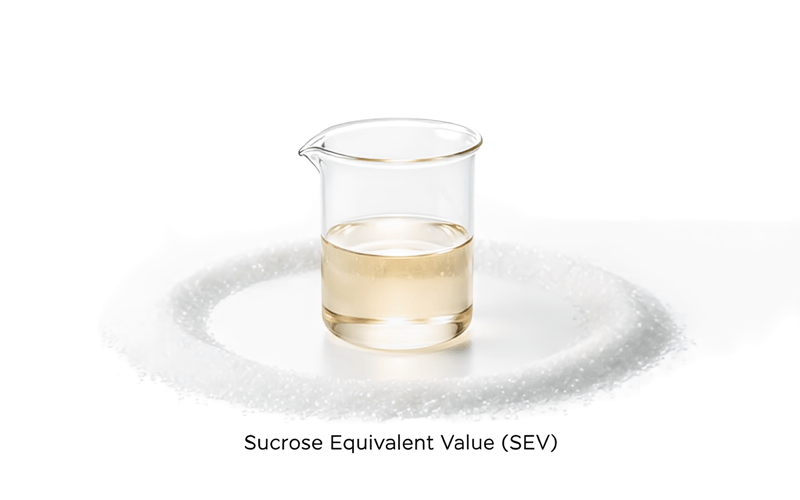
SEV expresses how much of a given ingredient is needed to match a specific percentage-sucrose-equivalent sweetness — for example, how many parts per million of a stevia extract are needed to match the sweetness of a 6% sucrose solution. Because it’s tied to a defined reference concentration, SEV allows a more direct comparison between two stevia products, or between stevia and another sweetener entirely, than a standalone “Nx sweeter” claim does.
How this connects back to steviol glycoside components
Stevia sweetness potency also varies by component — a Reb M-forward extract and a stevioside-forward extract standardized to the same total glycoside purity can show different SEV values, since the individual glycosides don’t all carry identical sweetness intensity per unit weight. This is part of why the component breakdown discussed in Steviol Glycoside Components: Why Reb A, Reb D, and Reb M Taste Different matters for potency comparison, not just taste comparison.
Reading a stevia spec sheet with this in mind
When comparing stevia sweetness potency across sources, look for the reference %SE the potency figure is based on, and ideally request potency data at more than one concentration if your application runs closer to the higher end of typical use levels — a syrup or tabletop sweetener formulated at higher sweetness intensity behaves differently than a lightly-sweetened beverage, and a single low-concentration potency figure won’t necessarily predict performance at the higher end.
Practical Considerations
Ask suppliers for SEV data at the concentration range relevant to your actual application, not just a single headline potency number. When switching between stevia sources, re-run a usage-level titration rather than assuming a directly proportional swap based on quoted potency alone — actual performance in your specific formulation matrix can shift the effective dose. For cost modeling, compare on a cost-per-SEV-unit basis rather than cost-per-kilogram, since potency differences materially change the effective cost of achieving a target sweetness.
Common Mistakes
Comparing two suppliers’ “Nx sweeter than sugar” claims without checking whether they’re quoted at the same reference concentration. Assuming potency scales linearly with concentration when reformulating from a lightly-sweetened to a more intensely-sweetened product format.
Key Takeaways
- Stevia sweetness potency is not a single fixed number — it depends on the reference concentration used.
- SEV standardizes the comparison by tying potency to a defined percent-sucrose-equivalent benchmark.
- Component profile (see Reb A vs. Reb D vs. Reb M) also affects potency, not just taste.
Conclusion
Comparing stevia sweetness potency accurately means asking suppliers for SEV data at a relevant concentration range, not accepting a single headline multiplier at face value. Once potency is on a comparable footing, the next practical question is usually how the ingredient actually behaves across the sweetness timeline in the mouth — covered in The Stevia Taste Curve: Understanding Onset, Peak, and Lingering Sweetness.
References
- https://www.ncbi.nlm.nih.gov/pmc/articles/PMC6266678/
- https://www.sciencedirect.com/science/article/pii/S0950329318310383
- https://www.sciencedirect.com/topics/food-science/sweetener-potency
- https://www.sciencedirect.com/topics/food-science/sweetener
- https://www.fao.org/fileadmin/user_upload/jecfa_additives/docs/monograph5/additive-442-m5.pdf