
Sourcing Satiety Ingredients for Contract Manufacturing: A Practical Guide
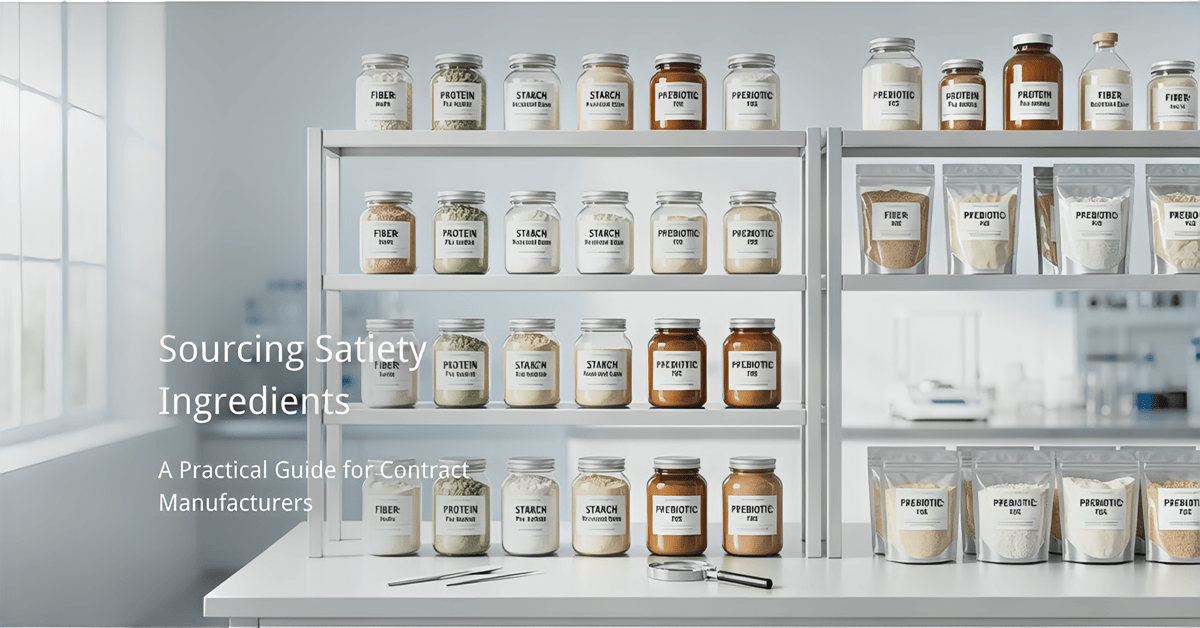
Formulating across five digestive phases, as covered throughout this series, means sourcing across a correspondingly wide ingredient range — bulking fibers, proteins, viscous fibers, resistant starches, and fermentable prebiotics rarely all come from the same manufacturer. For contract manufacturers building out a satiety-focused product line, that breadth creates real sourcing and documentation work.
Why this category is harder to source consistently than it looks
Unlike a single-ingredient product, a multi-phase satiety formulation depends on several functional properties — viscosity, hydrolysis degree, resistant starch content, fermentation rate — that don’t show up on a standard purity CoA. Sourcing satiety ingredients well means requesting the functional data specific to each ingredient’s mechanism, not just confirming identity and purity.
Documentation to request by ingredient category
For bulking fibers (glucomannan, psyllium husk): viscosity in mPa·s at a stated concentration and temperature, plus particle size distribution. For protein sources (whey, casein, collagen): amino acid profile, hydrolysis degree where applicable, allergen statement, and solubility data for the target format. For viscous fibers (beta-glucan) and resistant starch: molecular weight or resistant starch content by tested method (commonly AOAC), not inferred from amylose content alone. For fermentable fibers (inulin, FOS): degree of polymerization, since this directly affects fermentation rate and timing.

Consistency across batches matters more here than in most categories
Because this category’s functional performance depends on properties more sensitive to processing variation than simple purity, batch-to-batch consistency deserves more scrutiny than a standard qualification process typically applies. Asking whether a supplier tests these functional properties per batch or only at initial product qualification is a useful early question — the answer shapes how much ongoing verification your own QC process needs to build in.
Compliance documentation specific to this category
Beyond standard food-grade or pharma-grade certification (FSSC 22000, ISO 22000, or equivalent), confirm allergen control documentation for protein sources specifically, and Non-GMO or organic certification where relevant to your target market — these are more frequently requested in the satiety and functional-food category than in general excipient sourcing, given the consumer-facing positioning most finished products in this space carry.
A note on claims and documentation together
If your finished product will carry a satiety- or fullness-related claim, keep in mind that ingredient-level documentation supports formulation decisions — it doesn’t by itself substantiate a finished-product claim. This distinction is worth building into your own regulatory review process early, rather than treating ingredient specs and label claims as the same conversation; see Satiety Formulation Framework: Building a Multi-Phase Blend for Product Developers for more on how ingredient-level and finished-product-level evidence differ.
A practical sourcing sequence for a multi-phase product
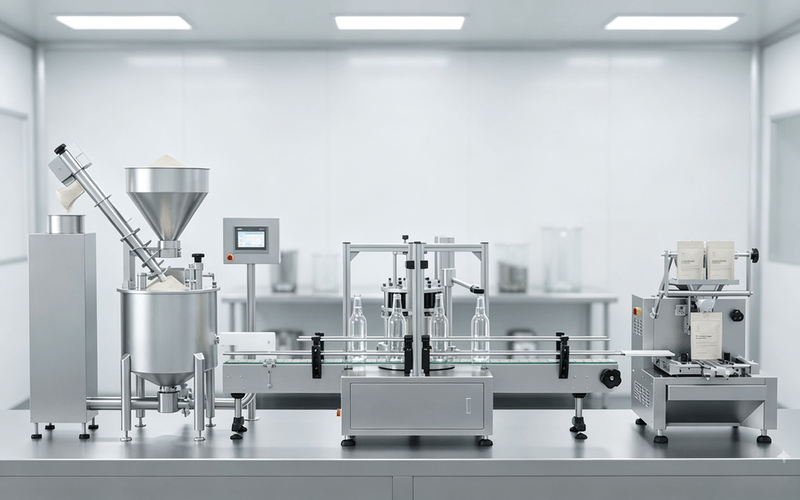
Given how many ingredient categories are typically involved, a practical approach is to qualify sourcing for one or two phases at a time — starting with whichever phase is the primary functional driver for your specific product — rather than trying to lock in a full five-phase ingredient list simultaneously. This makes pilot-batch iteration faster and limits how much qualification work needs to be redone if a specific ingredient choice changes during formulation testing.
We source across all five phases covered in this series — bulking fibers, protein and MCT, viscous fibers, resistant starch and FOS, and fermentable fiber and polyphenols — with functional and compliance documentation confirmed per batch. Tell us which phase you’re starting with, and we’ll walk through current options and samples.
References
- Nutrient detection by incretin hormone secreting cells — PMC — https://www.ncbi.nlm.nih.gov/pmc/articles/PMC3361765/
- Protein- and Calcium-Mediated GLP-1 Secretion: A Narrative Review — PMC — https://pmc.ncbi.nlm.nih.gov/articles/PMC8634310/