
Formulating Stevia for Bakery and High-Heat Applications
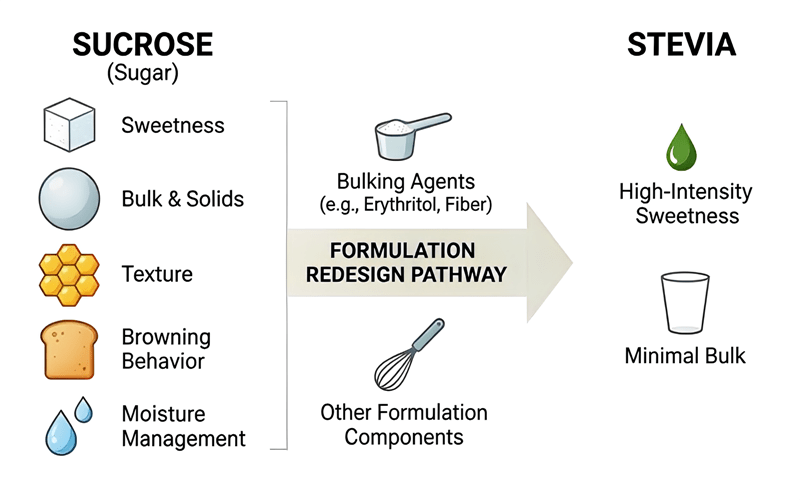
Stevia bakery applications require a different formulation approach from beverage or tabletop sweetener applications because sucrose does far more in a baked product than provide sweetness. Sucrose contributes to bulk, texture, moisture behavior, and browning. Replacing it with a high-intensity sweetener like stevia therefore requires those other functions to be addressed separately.
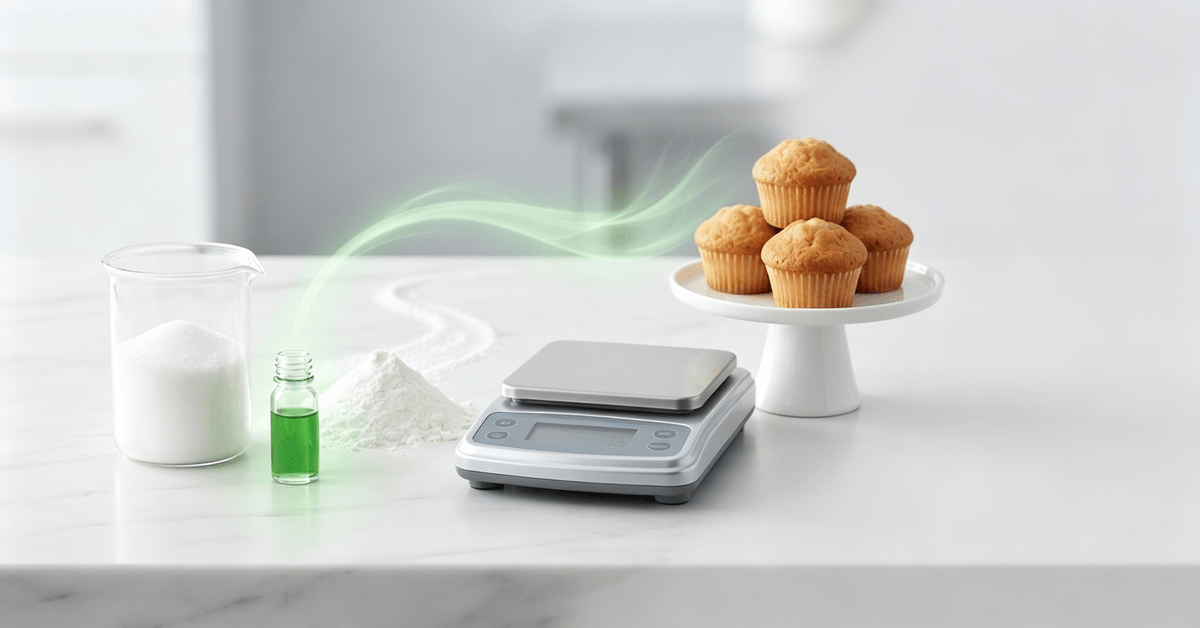
Stevia’s Heat Stability Is Generally Not the Limiting Factor
In stevia bakery applications, thermal stability is generally not the primary formulation challenge.
The more significant challenges come from what is lost when sucrose is removed from the formula. Studies and reviews on stevia applications in bakery products have reported changes in texture, color, browning, flavor, and other physical properties when sucrose is replaced with steviol glycosides.
The Bulk Problem in Stevia Bakery Applications
This is one of the main reasons stevia bakery applications usually require a separate bulking system.
A formula built around gram-for-gram sucrose replacement therefore creates a significant volume and solids gap, which can affect batter behavior, crumb structure, texture, and moisture distribution.
This is one of the main reasons stevia is rarely used alone in bakery formulations. A separate bulking system is typically needed to compensate for the physical contribution previously provided by sucrose.
The choice of bulking ingredient also matters. Different sugar substitutes can produce different effects on texture, volume, water activity, and other quality attributes in baked products.
For a broader discussion of stevia and complementary ingredients, see Stevia Blending Strategies: How Formulators Balance Taste, Cost, and Shelf Life.
The Browning Problem
Replacing sucrose can also change the color and flavor development of a baked product.
Sucrose is a non-reducing sugar, so it does not behave exactly like glucose or fructose in Maillard chemistry. During baking, sucrose can hydrolyze into glucose and fructose, while caramelization and other non-enzymatic browning reactions also contribute to the final crust color and flavor.
Because stevia does not provide the same sugar chemistry or solids contribution as sucrose, simply matching sweetness intensity does not guarantee the same crust color or flavor development.
Research on stevia-containing bakery products has reported changes in browning index and color when sucrose is replaced with steviol glycosides or stevia-based sweetener systems.
This means browning needs to be considered separately when designing a stevia-based bakery formulation.
The choice of bulking system, the presence of reducing sugars, moisture level, baking temperature, and baking time can all influence the final color and flavor profile.
Moisture and Shelf-Life Considerations
Sucrose also influences the moisture behavior of baked products. Removing it can therefore change water distribution, texture retention, and microbial stability during storage.
This is particularly important in intermediate-moisture bakery products.
Research evaluating commercial stevia-based sugar substitutes in bakery products found that different formulations could have substantially different humectant properties and water-activity behavior. The researchers concluded that replacing sucrose with stevia-based systems needs to be approached carefully because the bulking ingredients used can influence potential shelf life.
For this reason, shelf-life validation should not focus on stevia alone. The complete sweetening and bulking system should be evaluated under the intended storage conditions.
Practical Considerations for Stevia Bakery Applications
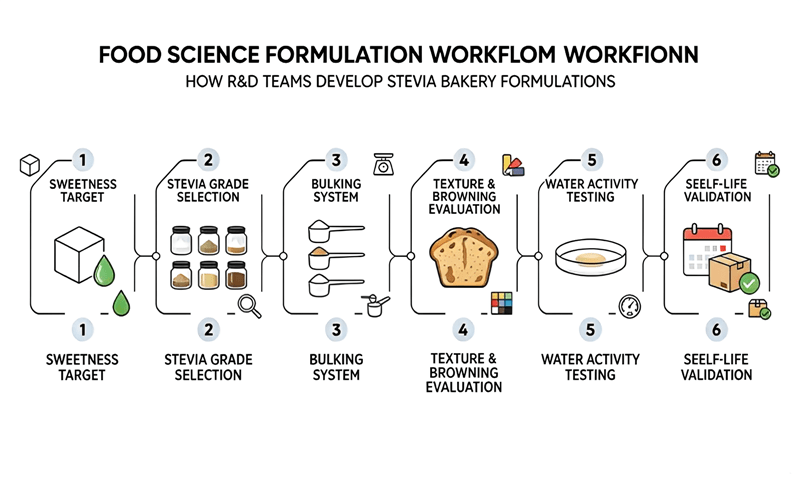
Successful stevia bakery applications should be developed around the complete product matrix rather than sweetness intensity alone.
The development process should address at least four separate questions:
• How much sweetness is required?
• How will the lost sucrose bulk and solids be replaced?
• How will the desired color and flavor development be achieved?
• How will moisture behavior and shelf life change during storage?
Pilot testing should be performed under representative formulation and baking conditions rather than relying only on bench-scale sensory testing.
It is also useful to compare more than one bulking system because different ingredients can produce materially different effects on texture, moisture, color, sweetness perception, and cost.
The actual product matrix matters. A sweetener system that performs well in a muffin may not behave the same way in a cookie, protein bar, nutrition product, or other baked application. Reviews of stevia applications consistently point to changes in dough or batter properties, texture, color, and flavor depending on the food matrix.
Common Mistakes
Reformulating for Sweetness Match Alone
A formulation can achieve the desired sweetness level while still producing a product with different volume, crumb structure, color, or moisture behavior.
Ignoring the Role of the Bulking System
The ingredient used to replace sucrose does more than provide volume. Its water-binding properties, thermal behavior, particle characteristics, and interaction with other ingredients can influence the finished product.
Assuming All Bakery Applications Behave the Same Way
A cookie, cake, muffin, protein bar, and baked nutrition product have very different formulation requirements.
A sweetener system that performs well in one application should therefore be validated before being transferred to another.
Underestimating Shelf-Life Changes
Removing sucrose can alter water activity and moisture distribution. In some bakery systems, this can affect texture retention and microbial stability during storage.
Key Takeaways
• Stevia’s heat stability is generally not the primary limitation in bakery applications.
• Replacing sucrose with stevia requires separate solutions for sweetness, bulk, texture, browning, and moisture behavior.
• The bulking system can significantly influence the final texture, color, moisture profile, and cost.
• Stevia-based bakery formulations should be evaluated in the actual product matrix and under representative baking and storage conditions.
• Shelf-life validation should consider the complete formulation rather than stevia alone.
Conclusion
Successful stevia bakery applications depend on treating sucrose replacement as a formulation redesign rather than a simple ingredient swap.
Stevia can provide the required sweetness intensity, but the rest of the formulation must compensate for the physical and functional roles previously provided by sucrose.
The most reliable approach is therefore to optimize sweetness, bulk, texture, browning, moisture behavior, and shelf life as connected but separate formulation variables.
For formulators working with high-heat applications, the next step is to verify whether the selected stevia grade and accompanying bulking system meet the required specification, documentation, and regulatory requirements for the target market.
See Sourcing Stevia Ingredients: A Procurement Checklist for Compliance and Specification Verification.
References
- Physical properties of muffins sweetened with steviol glycosides as the sucrose replacement — Journal of Food Science and Technology.
PubMed – Physical properties of muffins sweetened with steviol glycosides - Evaluation of the risk of fungal spoilage when substituting sucrose with commercial purified Stevia glycosides in sweetened bakery products — International Journal of Food Microbiology.
PubMed – Stevia glycosides and bakery shelf life - Stevia (Stevia rebaudiana) as a common sugar substitute and its application in food matrices: an updated review.
PubMed – Stevia applications in food matrices - Stability of steviol glycosides in several food matrices.
PubMed – Stability of steviol glycosides in food matrices - Do sugar substitutes affect quality characteristics and HMF levels of cakes?
PubMed – Sugar substitutes and cake quality