
Ingredient Sourcing Strategy: 7 Powerful Steps for Successful Product Development
An effective ingredient sourcing strategy helps turn a consumer trend into a practical product development plan.
A customer may say, “We want to develop a gut health product,” “We are exploring beauty from within,” or “We need a new concept for sports nutrition.” These statements provide a market direction, but they are not yet purchasing requirements.
Between a trend and a finished product lies a series of decisions. Which ingredient categories are relevant? What specifications are needed? Which formats suit the intended product? Can suitable materials be sourced consistently? Are the required documents available for the target market?
If these questions are left until late in development, the team may spend time evaluating ingredients that cannot meet its technical, commercial or documentation requirements.
The challenge is not simply finding an ingredient associated with a trend. It is translating that trend into specific, purchasable raw materials that fit the product concept, formulation requirements, supply plan and target market.

Why an Ingredient Sourcing Strategy Should Start With the Product Concept
Market trends are broad. Raw materials are specific.
“Gut health,” for example, may lead a development team to explore probiotics, prebiotic ingredients, selected botanical ingredients or combinations of different ingredient categories. The appropriate direction depends on the intended product, formulation objectives, target consumers, dosage format, market requirements and available evidence.
Similarly, a beauty-from-within concept may prompt research into collagen peptides, selected botanical extracts or other nutritional ingredients. Each option comes with different specifications, handling requirements, documentation needs, costs and formulation considerations.
A trend should therefore be treated as the beginning of the sourcing process, not the final purchasing brief.
A useful ingredient sourcing strategy connects three perspectives: what the market is asking for, what the product development team needs, and what the supply chain can realistically provide.
1. Translate the Trend Into a Clear Product Brief
Before searching for suppliers, define what the business is actually trying to develop.
A request such as “find ingredients for gut health” is too broad to produce a useful sourcing shortlist. It does not specify the product format, intended market, target price, ingredient restrictions or technical requirements.
A more actionable brief should cover:
- Product concept and intended positioning
- Target market and sales channels
- Dosage form, such as capsules, powders, gummies or liquids
- Preferred ingredient categories or excluded ingredients
- Target cost or approximate ingredient budget
- Required certifications, declarations or compliance documents
- Expected development timeline
- Estimated initial and future purchasing volumes
Not every detail needs to be finalized at the beginning. However, the sourcing team should understand which requirements are essential and which can remain flexible.
This helps narrow the search from a broad trend to a manageable set of ingredient options.
2. Identify Relevant Ingredient Categories Before Selecting Individual Materials
The next step is to identify which ingredient categories deserve evaluation.
For a gut health concept, the initial sourcing landscape might include probiotic strains, prebiotic ingredients and selected complementary ingredients. For beauty from within, the team might evaluate collagen peptides, botanical extracts and other ingredients that fit its product brief.
For sports nutrition, relevant categories may include amino acids, creatine and other functional ingredients. Weight management or longevity-oriented concepts may require a different review based on the intended product, formulation, evidence and market.
These examples are starting points, not automatic recommendations. An ingredient’s popularity does not establish that it is suitable for every formulation or that a particular product claim is justified.
The purpose of category mapping is to create a shortlist that can be evaluated against defined requirements.
For probiotics, for instance, strain identity and the amount of viable microorganisms are important considerations. The NIH Office of Dietary Supplements explains that probiotic microorganisms are identified by genus, species and strain, illustrating why a broad category name alone is not enough to define a purchasing requirement. NIH Office of Dietary Supplements: Probiotics
A well-structured shortlist gives R&D and procurement a clearer starting point than a long list of ingredients selected only because they are trending.
3. Convert the Concept Into Purchasable Specifications
Once the ingredient categories are identified, the sourcing team needs to define what an acceptable raw material looks like.
This is where ingredient sourcing becomes more technical.
Depending on the ingredient, specifications may include identity, assay, active content, standardization, particle size, solubility, moisture, water activity, microbiological limits, heavy metals, carrier composition or other parameters relevant to the intended application.
The required details vary by category.
A probiotic ingredient may require clearly defined strain information, viable count, storage conditions and shelf-life considerations. A botanical extract may require botanical identity, plant part, extraction details, marker compounds and carrier information. A powder intended for a specialized blend may need particular particle-size or flow characteristics.
The specification should reflect the actual application rather than relying only on a supplier’s standard product description.
This distinction matters because two materials can have similar commercial names but differ in characteristics that affect their suitability for a particular product.
Before requesting quotations, identify the critical parameters, acceptable ranges and required supporting documents. Where the formulation is still under development, separate confirmed requirements from parameters that need evaluation through samples or technical review.

4. Check Formulation Fit Before Comparing Prices
A material can be available at an attractive price and still be unsuitable for the intended product.
Formulation fit includes more than whether an ingredient can technically be purchased. It may involve solubility, dispersibility, taste, odor, particle size, flow properties, compatibility with other ingredients, processing conditions and storage requirements.
For example, an ingredient intended for a powder drink may need different handling characteristics from one intended for a capsule. Moisture-sensitive formulations may require closer attention to moisture-related parameters and water activity. A botanical extract containing a carrier may need to be evaluated against the product’s ingredient declaration and formulation restrictions.
These considerations should be reviewed with the formulation team and qualified technical personnel.
Where the fit is uncertain, requesting a representative sample and relevant technical documents can help determine whether the material deserves further evaluation. A sample is an evaluation step, not proof that the ingredient will perform identically at commercial scale.
Addressing formulation fit early can reduce the risk of choosing a material that later requires reformulation, a different grade or a new supplier.
5. Evaluate Supplier Capability, Not Just Product Availability
Finding a supplier that lists an ingredient is only the beginning.
The next question is whether that source can support the project’s actual requirements.
Supplier evaluation may include:
- Availability of the required grade or specification
- Minimum order quantity and trial-order flexibility
- Sample availability and lead time
- Production or supply lead time
- Consistency of specifications and documentation
- Batch identification and traceability
- Ability to address technical questions
- Relevant quality systems and supporting records
- Capacity to support larger orders if the project progresses
A supplier may be suitable for an early-stage trial but less suitable for repeated commercial purchases. Another source may offer a competitive bulk price but require an initial quantity that is too large for the project’s current stage.
For emerging brands and R&D teams, this difference can be important. The sourcing objective is not always to secure the lowest price immediately. It is to find a source that fits the project’s present needs while leaving a practical path for future purchasing.
Supplier qualification should be proportionate to the ingredient, its intended use, the target market and the level of risk.
6. Confirm Documentation and Market Requirements Early
Documentation should be reviewed as part of ingredient selection, not treated as a task to complete after a supplier has been chosen.
Depending on the ingredient and project, buyers may need a product specification, Certificate of Analysis (COA), SDS/MSDS, origin information, allergen information, Non-GMO documentation, organic documentation or other market-specific records.
Availability and applicability vary by ingredient, supplier and target market.
It is also important to distinguish between a document being available and a product being eligible for a particular regulatory status or label claim. A supplier declaration does not automatically replace third-party verification or other evidence that may be required. Likewise, an ingredient-level document does not automatically determine which claims can be made for the finished product.
For products intended for the United States, the FDA’s dietary supplement resources explain that companies are responsible for ensuring their products comply with applicable safety and labeling requirements. The FDA also describes notification requirements that may apply to new dietary ingredients. These issues should be checked against the actual ingredient and product plan rather than assumed from a supplier’s marketing description.
Useful starting points include the FDA’s dietary supplement industry resources and its New Dietary Ingredient Notification Process.
Confirming documentation early helps prevent a common sourcing problem: finding a technically interesting ingredient only to discover that the available records do not meet the project’s requirements.
7. Build a Sourcing Shortlist That Supports Both Trial and Scale-Up
A useful sourcing recommendation should provide more than a product name and price.
For each candidate, the buyer should be able to compare the relevant specification, documentation status, MOQ, sample availability, indicative pricing, lead time and any unresolved technical questions.
A simple comparison table can help the team distinguish between three types of options:
Preferred option: Meets the critical requirements and has suitable documentation and supply conditions.
Alternative option: Meets the main requirements but involves a trade-off, such as a different specification, higher MOQ or longer lead time.
Option requiring further validation: Potentially suitable, but one or more important details still need confirmation through technical review, documentation or sample evaluation.
This approach is particularly useful when the final formulation has not yet been locked.
It gives R&D and procurement a common basis for discussion and makes trade-offs visible. If the preferred ingredient is too expensive or unavailable in the required quantity, the team can assess alternatives without restarting the entire search.
The sourcing plan should also distinguish between a trial order and a commercial supply plan. A supplier that can provide a small sample may not necessarily be able to meet the expected commercial volume, so future availability and lead times should be confirmed rather than assumed.
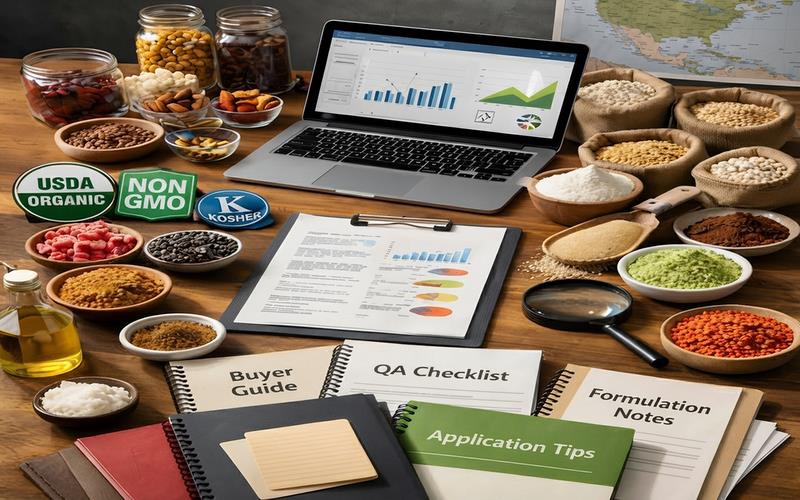
From Consumer Trend to a Practical Ingredient Sourcing Strategy
Turning a market trend into a product requires coordination between marketing, R&D, procurement, quality and the supply chain.
Marketing defines the opportunity and target positioning. R&D translates the concept into formulation requirements. Procurement evaluates available ingredients, specifications, suppliers and commercial conditions. Quality teams review documentation and determine whether the materials meet the project’s requirements.
When these discussions happen too late, teams may evaluate unsuitable materials, discover documentation gaps or repeat sourcing work.
When they happen early, the project can move forward with a clearer set of options and a more realistic view of cost, technical fit and supply conditions.
At Esubio, we support ingredient sourcing across application areas including gut health, beauty from within, sports nutrition, weight management and longevity-oriented formulations. Our ingredient scope includes probiotics, botanical extracts, amino acids, functional blends and other specialty ingredients, depending on project requirements and supplier availability.
We provide product specifications, COA and SDS/MSDS as applicable, with additional documentation depending on the ingredient, supplier and target market. Sourcing discussions can start with an early-stage product concept and progress toward a shortlist of purchasable materials, sample evaluation and potential commercial supply.
The objective is to help customers move from a broad product idea to a practical sourcing brief: specific ingredients, defined requirements, available documentation and realistic purchasing options.
A trend may explain why a product is worth developing. A well-planned ingredient sourcing strategy helps determine how that idea can move toward development and supply.
The starting point is not simply asking which ingredient is trending. It is asking which ingredient can meet the product’s actual requirements.
References
1.NIH Office of Dietary Supplements — Probiotics: Health Professional Fact Sheet
https://ods.od.nih.gov/factsheets/Probiotics-HealthProfessional/
2.U.S. FDA — Information for Industry on Dietary Supplements
https://www.fda.gov/food/dietary-supplements/information-industry-dietary-supplements
3.U.S. FDA — New Dietary Ingredient (NDI) Notification Process
https://www.fda.gov/food/dietary-supplements/new-dietary-ingredient-ndi-notification-process
4. U.S. FDA — Dietary Supplement Labeling Guide: Chapter VI. Claims