
Ingredient Transparency: 7 Powerful Checks for Better Raw Material Sourcing
Ingredient transparency is becoming an increasingly important part of raw material sourcing.
For brands, especially those operating in premium, DTC and clean-label markets, buying an ingredient is no longer only about finding the right product, price and delivery time. Buyers may also need to understand what the ingredient is, where it comes from, how it is documented, whether specific sourcing claims can be supported, and whether the relevant batch can be traced.
This does not mean that every ingredient needs an extensive marketing story.
It means that when a brand wants to communicate transparency to consumers or customers, the supply chain needs to provide information that can support that communication.
A typical situation is easy to imagine. A brand wants its product to emphasize clean-label positioning and asks its ingredient suppliers for source information, Non-GMO documentation and traceability records. One existing supplier can provide a product name and price but cannot clearly explain the source or provide the requested supporting documents.
The procurement team then has to find another source.
The problem is not necessarily the ingredient itself. The problem is that the sourcing information is not strong enough to support the brand’s requirements.
This is why ingredient transparency should be considered during supplier selection, rather than after the label and marketing strategy have already been developed.

Why Ingredient Transparency Starts With Sourcing
Ingredient transparency is often discussed as a consumer-facing issue, but much of it is created upstream.
A finished product label may contain a simple ingredient name. Behind that name, however, there can be multiple layers of information: botanical or raw material source, processing form, carrier, specifications, certifications or declarations, supplier identity and batch information.
If these details are unclear at the sourcing stage, it becomes much harder for a brand to answer basic questions later.
Where did this ingredient come from?
What exactly is the material?
What documentation supports its status?
Can the batch be linked to the relevant records?
Is the supplier’s documentation appropriate for the market and intended use?
The answers do not need to appear on the consumer label. But they may need to exist somewhere in the supply chain.
Ingredient transparency therefore starts with having the right information available before a material is approved.
1. Know Exactly What You Are Buying
The first ingredient transparency check is surprisingly basic: define the material precisely.
A product name alone may not provide enough information.
Two suppliers can offer products with similar names but different extraction ratios, carriers, grades, processing methods, origins or specifications.
For example, a botanical ingredient may need to be evaluated according to its botanical identity, plant part, extraction form, solvent system, standardization and carrier. A fruit powder may require information about the raw material source, processing method and whether additional carriers or processing aids are used.
The more specific the application, the more important this becomes.
A clear product specification gives procurement and quality teams a common reference. It also reduces the risk of approving a material based only on a commercial product name.
Ingredient transparency does not begin with a marketing claim. It begins with knowing exactly what is being purchased.
2. Do Not Treat a Product Name as Proof of a Label Claim
A supplier may describe an ingredient as “natural,” “clean label,” “non-GMO” or “organic,” but the commercial description itself should not automatically be treated as sufficient evidence for a finished-product claim.
This distinction is particularly important for organic ingredients.
USDA organic labeling rules define different categories and requirements for products marketed as organic in the United States. The eligibility of an organic claim depends on the applicable regulations, certification status, product composition and labeling category.
Therefore, an ingredient supplier document and a finished-product label claim are related, but they are not automatically interchangeable.
The same principle applies to Non-GMO positioning.
The Non-GMO Project Standard establishes specific requirements for products evaluated under its verification program. A general supplier statement should not be confused with participation in or certification under a specific verification program.
For procurement teams, the practical lesson is simple: identify exactly what claim the brand needs, then determine what type of evidence is actually required.
3. Ask What Evidence Supports the Ingredient Status
Ingredient transparency becomes meaningful when a supplier can provide supporting documentation.
Depending on the ingredient, market and supplier, relevant documents may include:
- Product specification
- Certificate of Analysis (COA)
- SDS or MSDS
- Country or source information
- Non-GMO statement or verification
- Organic certificate or applicable documentation
- Allergen information
- Manufacturing or processing information
- Batch or lot information
- Other market-specific compliance documents
The required documentation should be determined by the actual project.
For example, a brand developing an organic product may need documentation that supports the organic status of the relevant ingredient. A brand requiring Non-GMO sourcing may need a supplier declaration, verification or other evidence depending on its market and claim requirements.
The objective is not to collect documents simply because a supplier has them.
The objective is to have the right evidence for the specific requirement.

4. Supplier Transparency Matters as Much as Ingredient Transparency
A transparent ingredient is difficult to manage if the supplier behind it is not transparent.
Supplier qualification should therefore include more than price and lead time.
Buyers may want to understand:
- Who is supplying the material?
- Can the supplier provide consistent specifications?
- Are batch-specific documents available?
- Can source information be provided where relevant?
- Can the supplier explain changes in specification or source?
- Can quality questions be answered efficiently?
- Is documentation available for the intended market?
This does not mean that every buyer needs to investigate the entire supply chain in the same way.
The level of supplier verification should be proportionate to the ingredient, application, market and risk.
FDA’s supplier-related requirements for food imports, for example, use a risk-based approach to foreign supplier verification.
For ingredient procurement, the broader lesson is useful: supplier transparency is part of quality management, not simply a marketing advantage.
5. Batch Traceability Turns Transparency Into Evidence
A supplier may provide excellent information during the initial qualification process. But what happens when the material is actually delivered?
This is where batch traceability becomes important.
A batch or lot number can connect the physical material to its supporting documentation.
For example:
Ingredient → Supplier → Batch/Lot → COA → Shipment → Customer receiving record
This chain gives the buyer a way to connect what was purchased with the documents that describe it.
FDA describes food traceability as the ability to follow the movement of food and ingredients through the supply chain, including linking production, processing and distribution records.
For organic products, USDA requirements also use lot numbers or other unique information to connect containers to audit-trail documentation.
Even where a particular regulatory traceability requirement does not apply to a specific ingredient, the procurement principle remains useful: documentation becomes much more valuable when it can be connected to the actual batch received.
6. Clean Label Requirements Should Become Sourcing Requirements
“Clean label” can mean different things to different brands.
For one company, it may focus on a short ingredient list. For another, it may involve avoiding certain additives, using organic ingredients, sourcing Non-GMO materials or providing clearer origin information.
The problem begins when the marketing requirement is defined but the sourcing requirement is not.
Instead of simply telling a supplier:
“We need a clean-label ingredient.”
A more useful sourcing brief might specify:
- Required ingredient identity
- Preferred or restricted carriers
- Additive requirements
- Source requirements
- Non-GMO documentation
- Organic certification or documentation, if applicable
- Allergen requirements
- Country or regional requirements
- Required batch documentation
- Target specification
This turns a broad marketing concept into something procurement can actually evaluate.
Ingredient transparency becomes much easier to manage when the brand’s expectations are converted into measurable sourcing and documentation requirements.
7. Check Documentation Before Approving the Ingredient
One of the most expensive mistakes is to approve an ingredient based on a sample and price first, then ask for documentation after the brand has already built its formulation or label around the material.
Documentation should be part of the qualification process.
Before approving a new ingredient, buyers should ask:
Does the specification match the intended application?
Can the supplier provide the required COA?
Is the source information available where needed?
Can the requested Non-GMO or organic status be supported?
Can the relevant batch be traced?
Are the documents consistent with the actual material being supplied?
Can the documentation support the target market?
These questions are especially important when the ingredient is intended for a product with a strong transparency or clean-label positioning.
A good ingredient that cannot satisfy the project’s documentation requirements may still be the wrong sourcing choice.
Ingredient Transparency Is a Supply-Chain Capability
Ingredient transparency should not be treated as a final marketing exercise.
It is built through the sourcing process.
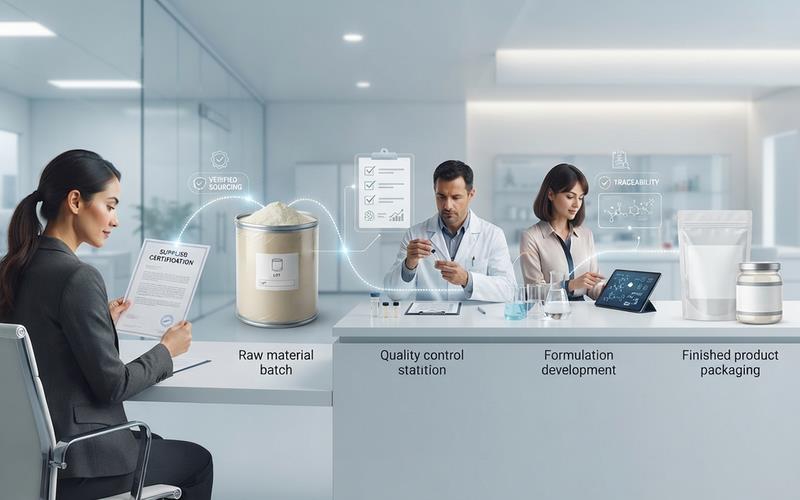
The product specification defines what is being purchased. Supplier documentation provides supporting information. Batch identification connects the physical material with its records. Supplier qualification helps assess whether the source can consistently provide the required information.
Together, these elements create a more reliable foundation for brand communication.
It is also important to distinguish between ingredient-level evidence and finished-product labeling requirements.
For example, having documentation related to an organic ingredient does not automatically mean that a finished product can use any desired organic claim. USDA rules establish specific requirements for organic labeling categories and certification.
Likewise, a supplier’s Non-GMO statement should not automatically be presented as equivalent to a specific third-party verification program.
The correct approach is to match the evidence to the claim, market and regulatory framework.
What Should Buyers Ask Before Approving a Transparent Ingredient?
A practical pre-approval checklist can include:
- What exactly is the ingredient and grade?
- What is the source or origin information?
- What specifications apply?
- What documentation is available?
- Is a batch-specific COA provided?
- Can the batch be traced to the relevant records?
- Is Non-GMO documentation available if required?
- Is organic certification or applicable documentation available if required?
- Are carriers, additives and processing details relevant to the brand’s clean-label requirements?
- Do the available documents support the intended market and product claim?
These questions do not make sourcing unnecessarily complicated.
They help prevent a more expensive situation later, when procurement discovers that the selected ingredient cannot support the documentation or transparency requirements of the finished product.
Transparency Should Start Before the Label
A brand’s transparency story should not begin with the artwork on the packaging.
It should begin much earlier, when the ingredient is selected.
For ingredient sourcing, Esubio can provide product specifications, COA and SDS/MSDS with shipments, while additional documentation such as Non-GMO statements, organic documentation and batch-related information may be available depending on the ingredient, supplier and target market.
Supplier sources are evaluated based on the actual project requirements, with documentation reviewed as part of the sourcing process.
The goal is straightforward: when a brand asks where an ingredient comes from, what it is, or what documentation supports its status, the supply chain should have a clear answer.
Ingredient transparency is not about making a product sound better.
It is about making the information behind the product easier to verify.
When transparency is built into sourcing from the beginning, the label is no longer making a promise that the supply chain cannot support.
It is simply communicating a product whose underlying information has already been checked.
Transparency should start at sourcing — not at the label.
References
USDA — Labeling Requirements for the U.S. Organic Market
USDA — Labeling Organic Products
FDA — Foreign Supplier Verification Programs
FDA — Tracking and Tracing of Food
The Non-GMO Project — The Non-GMO Project Standard
The Non-GMO Project — Program Rules and Procedures